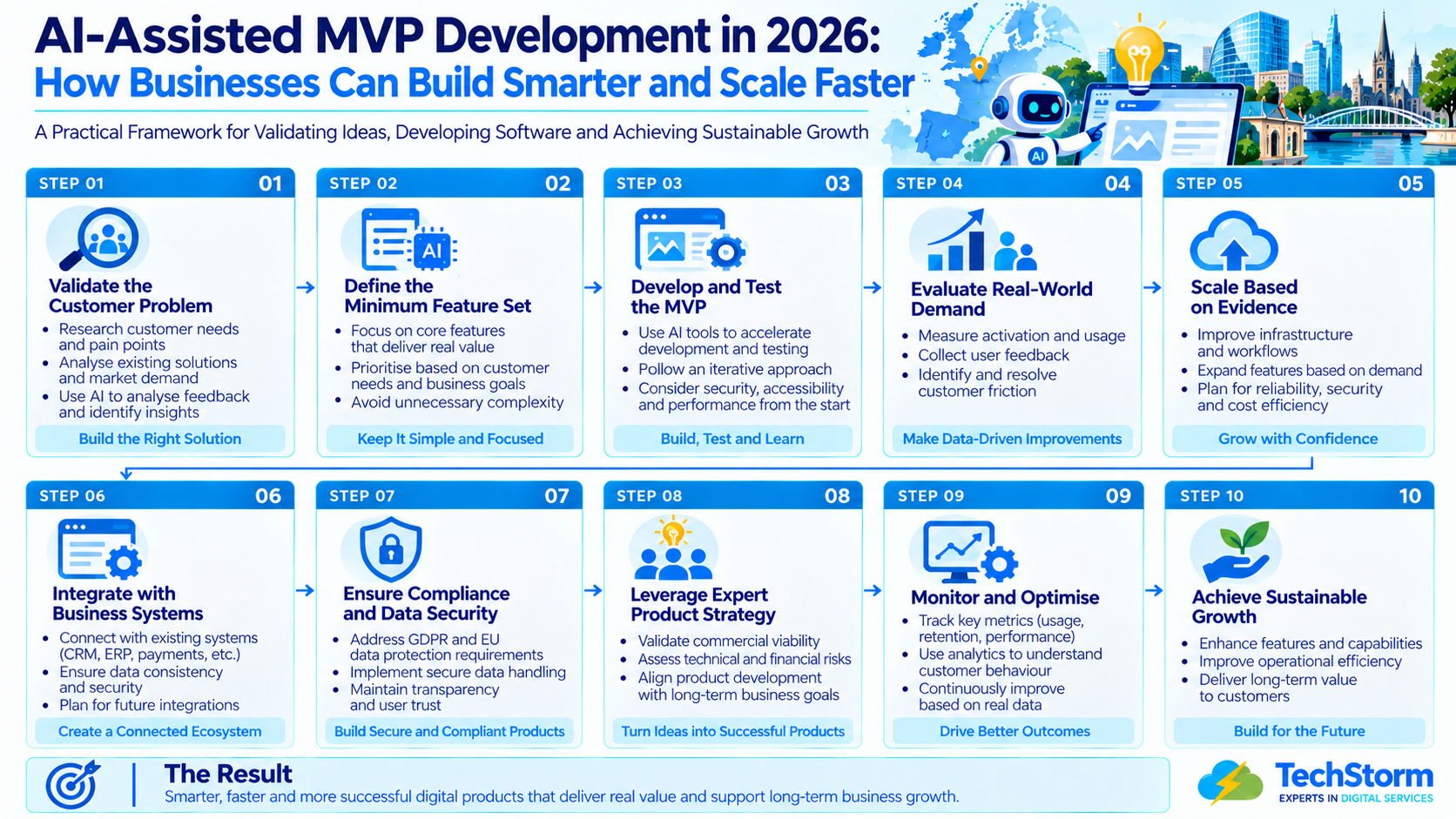
AI-Assisted MVP Development – Key Highlights
- Validate first: Use customer evidence to test whether the product solves a real problem.
- Use AI thoughtfully: Support research, prototyping, development and testing with human oversight.
- Keep the MVP focused: Build the smallest functional product that tests the key business assumption.
- Plan for growth: Assess security, accessibility, maintenance and operating costs from the beginning.
- Scale on evidence: Expand after demonstrating demand, product usage and technical stability.
AI-assisted MVP development is changing how businesses validate ideas, develop software, and prepare for growth in 2026. For businesses in Dublin, across Ireland, and in the UK, the opportunity is to create digital products that solve genuine customer problems and deliver measurable value.
AI-assisted MVP development is changing how businesses validate ideas, develop software, and prepare for growth in 2026. By combining artificial intelligence with product discovery, lean development, and human expertise, organisations can explore concepts more efficiently without committing immediately to expensive software projects.
For businesses in Dublin, across Ireland, and in the UK, the opportunity is not simply to develop applications faster. It is to create digital products that solve genuine customer problems, deliver measurable value, and support sustainable growth.
However, AI cannot replace commercial judgement, customer research, or responsible engineering.
Why AI-Assisted Product Development Is Gaining Momentum in 2026
Artificial intelligence is becoming increasingly integrated into software product development.
A 2026 systematic literature review published in Technovation, examining 98 research articles, found that AI can support information processing and decision-making across different stages of product development.
Potential applications include:
- Analysing customer feedback and product requirements.
- Creating early prototypes and testing alternatives.
- Supporting software development and automated testing.
- Identifying usability issues before release.
- Analysing product performance after launch.
These capabilities can improve development workflows, but their effectiveness depends on data quality, oversight, and business readiness.
Businesses exploring digital product development services should therefore consider how AI supports an established product strategy rather than treating automation as the strategy itself.
How AI Is Transforming Custom Software Product Development
Traditional software projects can involve lengthy planning cycles, complex technical decisions, and expensive revisions.
AI-assisted workflows can help teams examine requirements, generate implementation options, and identify potential problems earlier.
However, custom software product development still requires experienced professionals to evaluate security, architecture, maintainability, and integration requirements.
For example, consider an Irish professional services company developing a customer management platform.
AI could assist with organising requirements, drafting interface concepts, and generating test cases. Developers would still need to validate system behaviour, manage permissions, assess integrations, and ensure appropriate data protection.
The most practical approach combines automation with accountable engineering decisions.
This becomes especially important when software must connect with existing business systems.
Why Product Strategy and Innovation Consulting Still Matter
Faster development does not automatically produce a commercially successful product.
Before investing in technology, organisations need to establish whether customers genuinely need the proposed solution.
Effective product strategy and innovation consulting should answer several questions:
- What customer problem will the product solve?
- Who will use it, and how frequently?
- Which features are essential for the first release?
- What evidence will demonstrate commercial viability?
- What technical, financial, or regulatory risks exist?
For example, a business planning an AI-powered customer portal should first determine whether automation addresses a real service problem.
If customers primarily need simpler navigation or faster access to information, introducing complex AI functionality could increase costs without improving outcomes.
TechStorm's technology consulting services provide a relevant starting point for organisations evaluating their wider technology requirements.
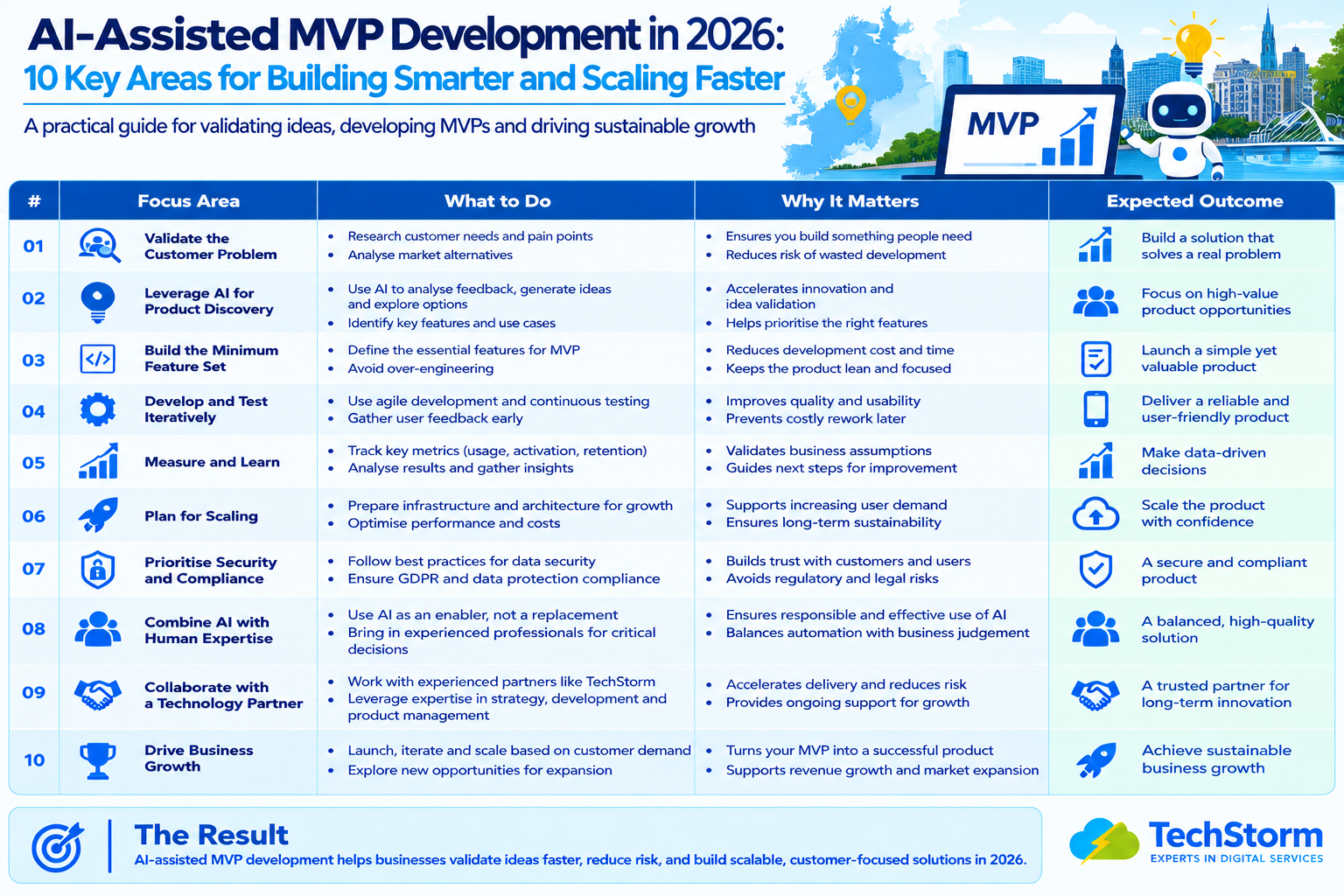
MVP Development and Scaling: A Practical 2026 Framework
A minimum viable product, or MVP, is the simplest functional version of a product designed to test its most important business assumption.
Successful MVP development and scaling requires different priorities at each stage.
| Stage | Primary objective | Key measurement |
|---|---|---|
| Discovery | Validate the customer problem | Research findings |
| Prototype | Test usability and workflows | Task completion |
| MVP launch | Evaluate real-world demand | Activation and usage |
| Improvement | Resolve customer friction | Retention |
| Scaling | Support growing demand | Reliability and cost efficiency |
Step 1: Validate Before Building
Interview prospective customers, examine existing alternatives, and identify the problem worth solving.
AI can assist with synthesising findings, but genuine customer evidence must guide decisions.
Step 2: Define the Minimum Feature Set
Prioritise features essential to delivering the product's core value.
Avoid adding sophisticated AI functionality simply because it is available.
Step 3: Develop and Test
Use iterative development to release functionality, gather feedback, and correct issues.
Security, accessibility, and performance should be considered from the beginning.
Step 4: Scale Based on Evidence
Once adoption is demonstrated, improve infrastructure, refine workflows, and expand capabilities.
For mobile-focused products, TechStorm's enterprise mobility solutions address application development and scalable mobile environments.
Three Mistakes Businesses Should Avoid
1. Confusing Faster Coding With Faster Validation
Generating code quickly has limited value when product requirements remain untested.
Prioritise customer discovery before increasing development capacity.
2. Introducing AI Without Clear Business Value
Not every software product requires artificial intelligence.
Evaluate whether AI will materially improve customer experience, reduce operational effort, or support better decisions.
3. Ignoring Long-Term Maintenance
An MVP must be affordable to operate and practical to improve.
Review code quality, technical documentation, infrastructure costs, and data protection requirements before expanding the product.
For businesses operating in Ireland or serving EU customers, GDPR considerations should be assessed whenever personal data is processed.
How TechStorm Supports Digital Product Innovation
TechStorm provides digital product development services covering strategy consulting, agile development, strategic product management, and product value optimisation.
Its approach emphasises customer input, technology-led innovation, and iterative product improvement.
For organisations developing new solutions or improving existing platforms, these capabilities can support more informed planning and development decisions.
Businesses exploring software innovation can contact TechStorm to discuss project requirements and potential next steps.
Planning an MVP or Digital Product?
Discuss your product idea, customer needs, technical requirements, and next steps with TechStorm.