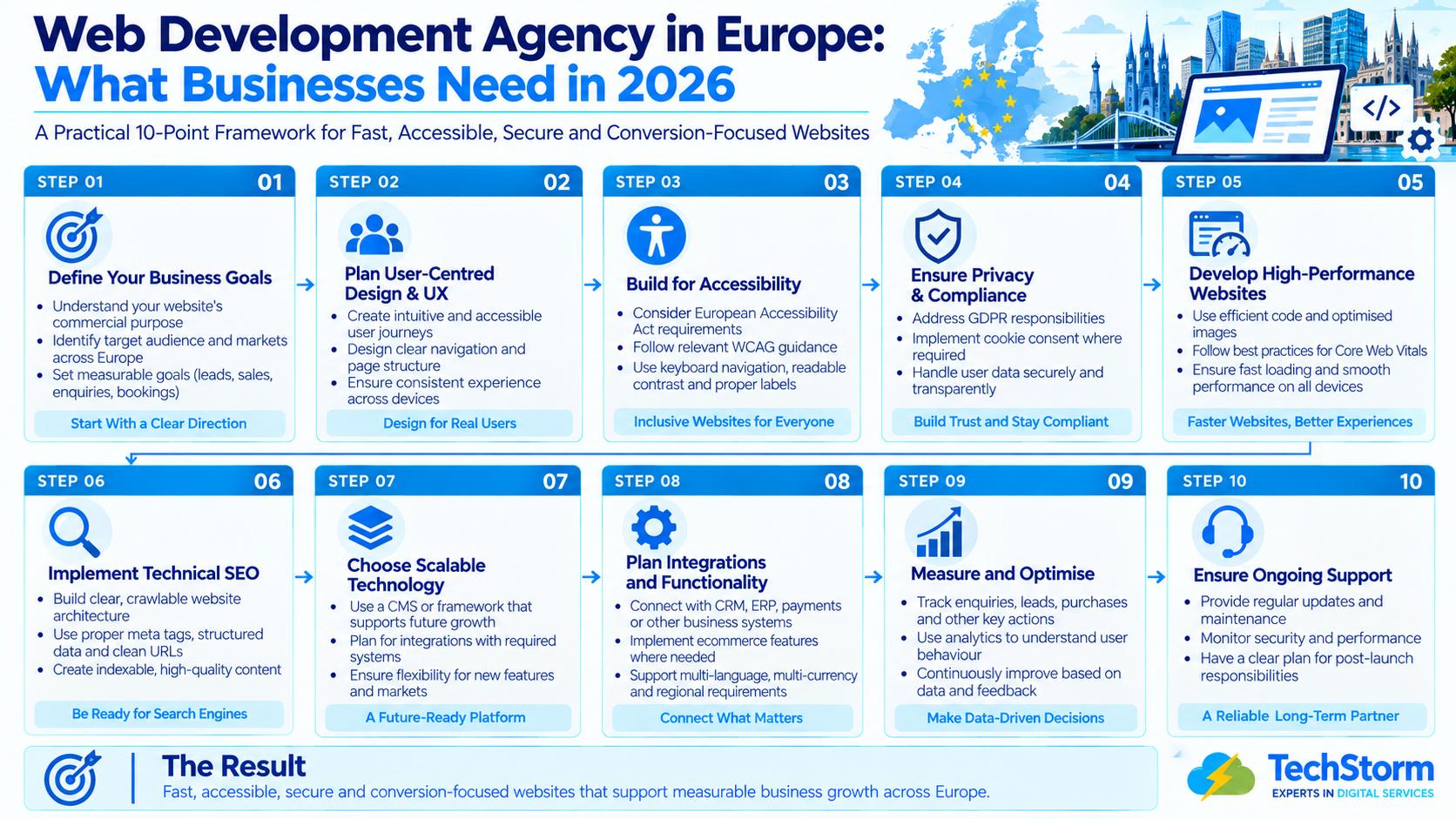
Web Development in Europe – Key Takeaways
- Performance: Prioritise responsive layouts, efficient code and fast loading.
- Accessibility: Consider applicable European Accessibility Act requirements and inclusive design.
- Privacy: Address GDPR responsibilities and relevant cookie consent requirements.
- Scalability: Choose technology that supports future integrations and growth.
- SEO and conversion: Build clear architecture and measure meaningful actions.
Choosing a web development company in Europe in 2026 means looking beyond attractive website design. Businesses need fast, accessible, secure and conversion-focused digital experiences that work across devices, support international audiences and accommodate applicable European regulations.
Whether you are launching a business website, developing an ecommerce store or replacing an outdated platform, the right development approach should support measurable business goals. This guide explains what to evaluate when hiring a European web development partner and how TechStorm's Ireland-based web development services fit into the process.
Key Takeaways
- Performance: Prioritise responsive layouts, efficient code and fast loading.
- Accessibility: Consider applicable European Accessibility Act requirements and inclusive design.
- Privacy: Address GDPR responsibilities and relevant cookie consent requirements.
- Scalability: Choose technology that supports future integrations and growth.
- SEO: Build clear website architecture, indexable content and effective internal navigation.
- Conversion: Measure enquiries, qualified leads, purchases and other meaningful actions.
1. Why Web Development in Europe Is Changing in 2026
European businesses increasingly use their websites for more than presenting company information.
Websites now support ecommerce transactions, customer enquiries, online appointments, service delivery and integrations with operational systems.
A company selling across several European markets may need different languages, currencies, delivery information and legally appropriate privacy disclosures.
This creates an important distinction between launching a website and developing a business-ready digital platform.
A professional web development agency in Europe should establish the site's commercial purpose before recommending technology.
For example, a B2B consultancy may need a clear service architecture and lead-generation forms, while an online retailer may prioritise product discovery, checkout usability and secure integrations. Both require different solutions despite operating in the same digital market.
2. European Accessibility Requirements Deserve Attention
One of the significant considerations for European web projects is digital accessibility.
The European Accessibility Act began applying on 28 June 2025. It establishes accessibility requirements for certain products and services, including covered ecommerce services.
Its application depends on the service, national implementation, transitional provisions and relevant exemptions. Therefore, not every private business website is automatically subject to identical obligations.
However, accessibility remains an important development objective even where particular legal duties do not apply.
Accessibility features worth prioritising
- Navigation that works using a keyboard.
- Text with readable contrast.
- Meaningful labels for interactive elements.
- Appropriate alternative text for informative images.
- Forms with understandable instructions and error messages.
- Layouts that adapt to different screen sizes.
Businesses should consider recognised accessibility guidance, including relevant WCAG success criteria, during development and testing. Accessibility is not a feature that should be judged only through automated testing. Manual testing and, where practical, testing with assistive technologies remain valuable.
3. What Should a Web Development Company in Europe Deliver?
The best solution depends on project requirements, but businesses should expect a structured development process.
| Development area | Business consideration |
|---|---|
| Website architecture | Clear navigation and logical page structure |
| UX/UI design | Accessible, intuitive user journeys |
| Responsive development | Consistent functionality across devices |
| Technical SEO | Crawlable pages and appropriate metadata |
| Security | Secure configuration and maintenance |
| Integration | Reliable connections with required systems |
| Analytics | Measurement of meaningful business outcomes |
| Support | Defined post-launch responsibilities |
A business website should be easy for visitors to understand and straightforward for internal teams to maintain. TechStorm's web development services in Ireland describe business websites, ecommerce stores, custom web applications, landing pages and website redesigns.
4. Website Performance and SEO Should Be Planned Together
Website development and search engine optimisation are closely connected.
A visually impressive page may still struggle to attract organic visitors if important content cannot be crawled or pages are unnecessarily slow.
Google's Core Web Vitals provide useful metrics for evaluating aspects of loading performance, responsiveness and visual stability. However, passing these metrics alone does not guarantee high search rankings.
Technical priorities for 2026
- Logical architecture: Organise services and supporting pages around distinct search intents.
- Mobile usability: Ensure important content and functionality remain accessible on smaller screens.
- Efficient loading: Optimise images, scripts, fonts and other performance-sensitive resources.
- Structured information: Use appropriate headings, metadata and schema markup.
- Internal linking: Connect related content using descriptive anchor text.
- Indexing controls: Manage canonical URLs, redirects and robots directives correctly.
For multi-country projects, additional considerations may include language-specific URLs and
hreflang
implementation where appropriate. These technical foundations support search visibility while making websites easier to navigate.
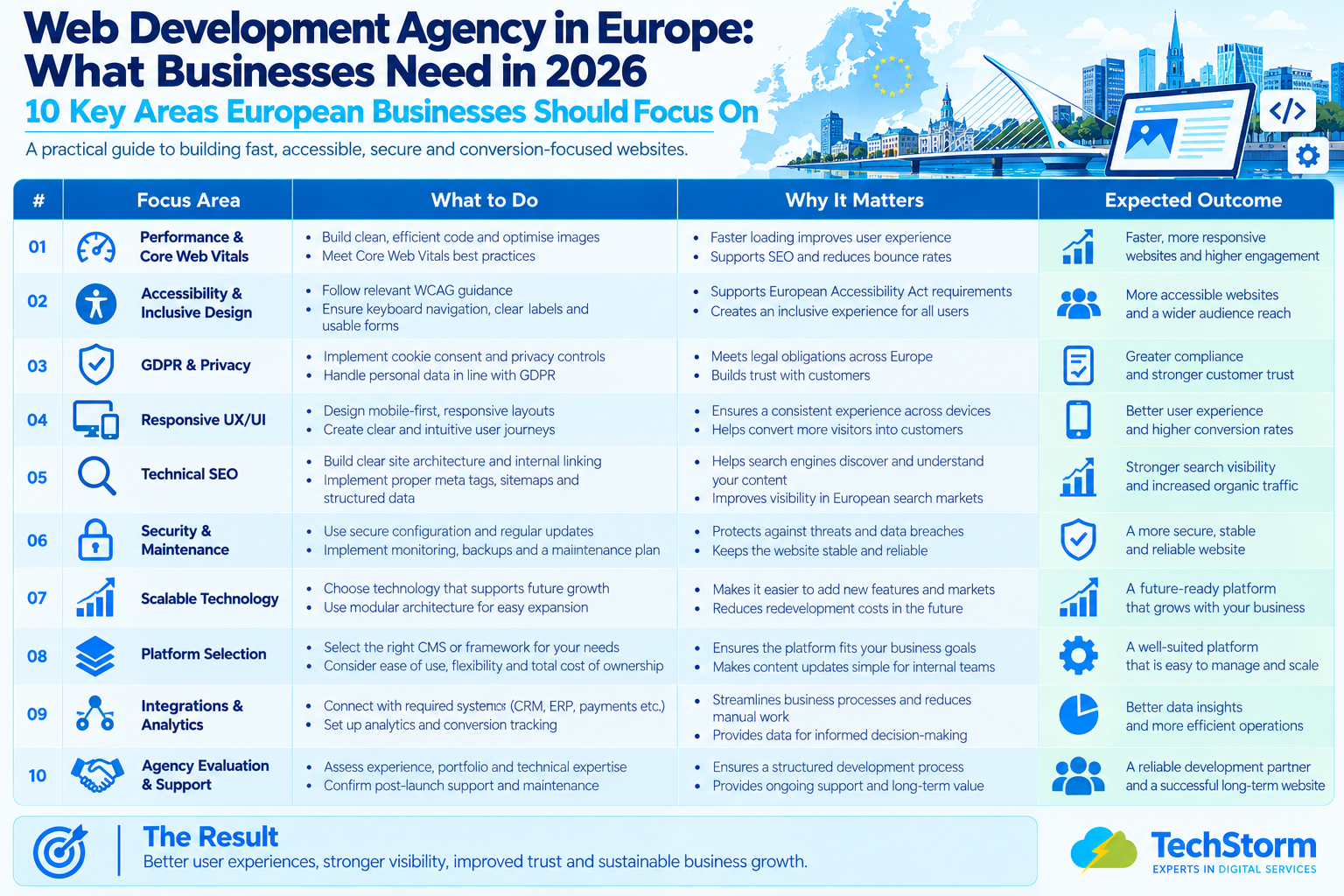
5. GDPR and Privacy Considerations for European Websites
Privacy requirements are another important part of web development.
The General Data Protection Regulation applies to personal data processing within its defined territorial scope.
Businesses collecting information through contact forms, analytics, advertising technologies or online accounts should identify their processing activities and applicable legal obligations.
Development teams can support privacy requirements through technical implementation. Examples include appropriate access controls, secure data transmission, configurable consent mechanisms and clear information collection processes.
Where consent is required for particular cookies or tracking technologies, websites should obtain valid consent before activating them.
Importantly, installing a cookie banner does not automatically make an entire website GDPR-compliant. A company remains responsible for determining its legal obligations and verifying that its operational practices meet them.
6. Custom Development or an Established Website Platform?
Not every company needs a completely custom application.
WordPress, Shopify, WooCommerce and other established platforms can be suitable for many business websites.
Custom development may be preferable when standard platforms cannot support essential workflows or integrations without excessive complexity.
The decision should consider security, maintainability, licensing costs, integrations and the skills required for ongoing administration.
| Project requirement | Potential approach |
|---|---|
| Small business website | Content management system |
| Online product store | Ecommerce platform |
| Marketing landing pages | CMS or custom frontend |
| Customer booking portal | Custom development or suitable platform |
| Complex operational workflow | Custom web application |
| Existing outdated website | Redesign or platform migration |
TechStorm offers website design and SEO services , including responsive interfaces, custom design and SEO-ready website structures.
7. How Should Businesses Evaluate a Web Development Agency in Europe?
Price alone is rarely a sufficient selection criterion.
Two agencies may quote different amounts because they have interpreted the project scope differently. Before comparing proposals, establish what each quotation includes.
Ask potential partners about discovery and requirements documentation; design revisions and approval stages; technology selection and ownership; accessibility and performance testing; security responsibilities; content migration and redirect planning; and post-launch support and maintenance.
The delivery model also matters. Some businesses prefer dedicated development resources, while others require a defined project with agreed deliverables. TechStorm publishes engagement and delivery models that include offshore, onsite, hybrid and dedicated-team arrangements. Businesses should clarify which model is appropriate for the proposed project.
8. Why Consider TechStorm for Web Development?
TechStorm Consulting Ltd. provides technology consulting and digital services, with published experience supporting businesses in Ireland and the UK.
Its website development capabilities include responsive design, custom web development, ecommerce solutions, web application interfaces and SEO-friendly website structures.
The company also publishes services involving enterprise technology consulting, mobility and product development. For organisations evaluating a development partner, this broader technical portfolio may be relevant when websites need to connect with other business systems.
TechStorm should nevertheless be assessed against the specific project requirements, including required integrations, delivery timelines and technical responsibilities.
Build a Website That Supports Long-Term Business Growth
Your website should help customers understand your services, trust your business and complete meaningful actions. In 2026, that requires a combination of strategic planning, accessible design, appropriate technology, technical SEO and ongoing performance measurement.
Whether your organisation needs a new corporate website, an ecommerce platform or a modernised digital experience, start with clear business objectives.
Ready to Discuss Your Web Development Requirements?
Contact TechStorm to discuss your business goals, project requirements and the most appropriate development approach.
Email:
info@techstorm.ie
Phone:
+353 1 962 9946
Company:
TechStorm Consulting Ltd., Ireland